A valid BitLocker password or 48-digit recovery key is required to unlock the drive and access your data.
BitLocker provides industry-standard encryption. Without the correct credentials, a BitLocker drive cannot be unlocked.
When you encounter any of the following situations, a BitLocker for Mac solution can help you access your drive on macOS:
The BitLocker drive is not accessible in Finder or on the desktop.
You see the error "The disk you attached was not readable by this computer" after connecting a BitLocker drive to a Mac.
You want to open a Windows BitLocker USB drive on a Mac.
You want to encrypt an external drive with BitLocker for cross-platform use.
You need to unlock the BitLocker drive on a Mac using the 48-digit recovery key after forgetting the password.
Note: If you have lost both the BitLocker password and recovery key, the encrypted drive cannot be unlocked.
macOS doesn't natively support BitLocker. iBoysoft BitLocker for Mac bridges this compatibility gap by enabling macOS to unlock, mount, access, and write to BitLocker-encrypted drives using a valid password or 48-digit recovery key.
Mount and open USB drives encrypted by BitLocker Drive Encryption or BitLocker To Go as any Mac-friendly drives.
View, edit, delete, or rename files on a BitLocker drive on your Mac. Also, create, add, or copy new files to the BitLocker drive.
Employs Windows BitLocker Drive Encryption to encrypt an external disk formatted as NTFS, FAT32, or exFAT on a Mac. When prompted, remember to back up the recovery key.
Move and copy files between your Mac and an external BitLocker To Go USB flash drive, SSD, HDD, SD card, or other storage device seamlessly.
NTFS, FAT32, and exFAT drives enabled by BitLocker encryption on a Windows PC can also be unlocked, mounted, opened, and edited on a Mac.
Once you agree to store the password in Keychain, the drive will be opened automatically next time it is plugged in.
Keeps up with the latest operating systems and Mac models. For Apple silicon M5, M4, M3, M2, and M1 Macs, you should enable system extensions.
With its clean, intuitive interface, the best BitLocker for Mac software lets you open and use BitLocker-encrypted drives on your Mac as easily as a native Mac drive.
Download and install it
You need to enable system extension on an Apple Silicon Mac and grant the software Full Disk Access if required.
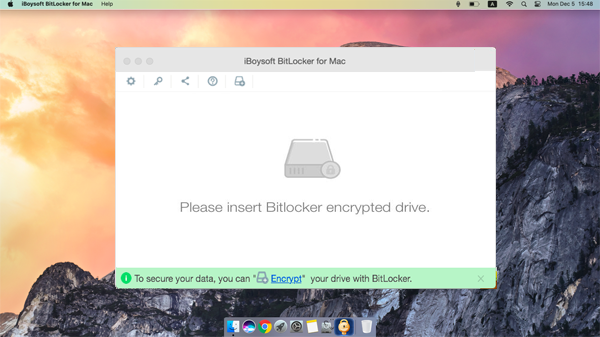
Insert a BitLocker-encrypted drive
Connect a BitLocker-encrypted drive to your Mac computer.
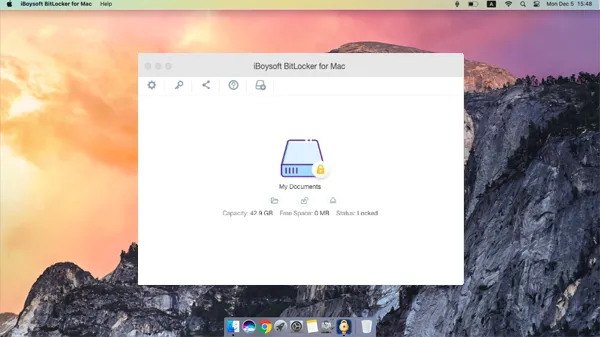
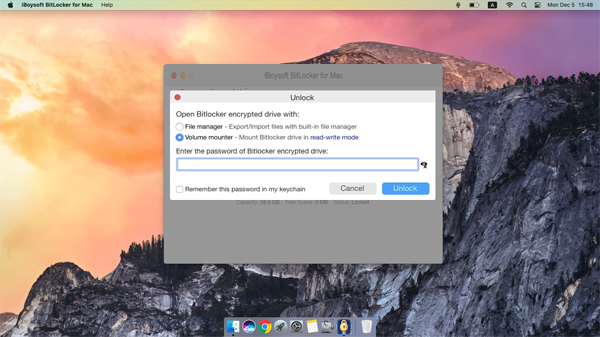
Access BitLocker drives on Mac
Open iBoysoft BitLocker for Mac, click the unlock button on the app's main interface, enter your password or recovery key to unlock and read-write the BitLocker disk.
Learn more >>
Use this BitLocker for macOS tool to easily encrypt USB drives for Mac and Windows with BitLocker, protecting your files.
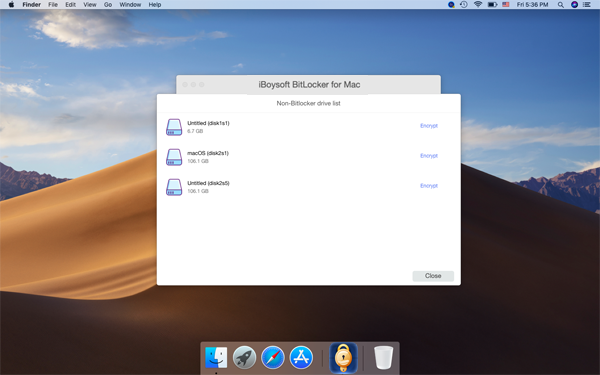
Select a disk and click Encrypt
Click the "Encrypt" button, select a disk, and click "Encrypt". Only a GPT or MBR disk with FAT32, exFAT, or NTFS file system can be encrypted by the BitLocker Encryption method.
Set up BitLocker password
Enter your password twice (No length or strength requirements).
Back up the recovery key and start encryption
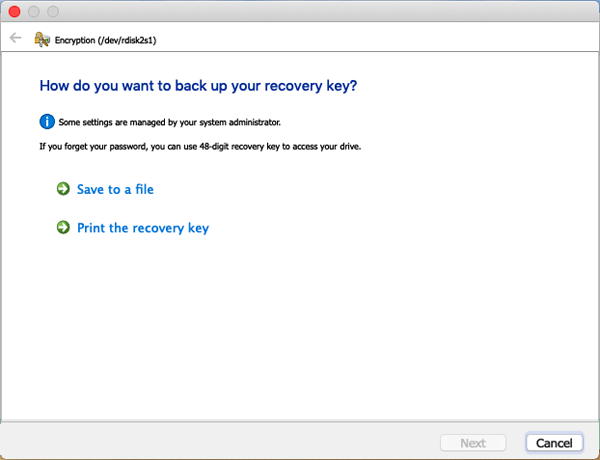
Select a way to store your recovery key, then click "Next". The BitLocker password or recovery key needs to be kept in a safe place; otherwise, the data will become inaccessible if you lose both. Click "Start Encryption". The process can't be canceled during the encryption.
Learn more >>


All legitimate BitLocker solutions can't unlock a BitLocker-encrypted drive if:
⚠️ If your drive is corrupted or physically damaged, stop using it immediately. Determine how to recover data from a BitLocker-encrypted drive appropriately before making any changes to avoid permanent data loss.
BitLocker is Microsoft's proprietary disk encryption technology, and Apple doesn't implement native support for BitLocker in macOS. Although macOS can detect the connected storage device, it can't unlock or mount the BitLocker-encrypted volume. As a result, the data stored on the drive remains inaccessible.
Yes, it is designed to safely unlock and mount BitLocker drives with a valid password or recovery key. This tool won't bypass the encryption and also won't corrupt your data while you are using it.
Your BitLocker recovery key may be stored in your Microsoft account, saved to a file, printed on paper, or backed up by your organization if the device is managed by work or school. You can also check the Windows device where BitLocker was enabled. If you're unable to locate it, refer to Microsoft's official recovery key guidance.
No. Unlocking a BitLocker drive only grants temporary access to its encrypted data during the current session. The drive remains protected by BitLocker and will require the password or recovery key again after it is disconnected or the system restarts. Only turning off BitLocker on a Windows PC or formatting the drive can permanently remove encryption.
You need to install a BitLocker for Mac tool like iBoysoft BitLocker for Mac to unlock a BitLocker-encrypted drive on a Mac.
To unlock a BitLocker-encrypted drive, you'll need either the BitLocker password or the 48-digit BitLocker recovery key. BitLocker password is your normal use for unlocking the drive. The 48-digit recovery key is the backup key used if you've forgotten the password or BitLocker requires additional verification. If you need help finding your recovery key, see Microsoft's official guide: Find your BitLocker recovery key.
Your disk is encrypted by BitLocker, so you have to have either the password or the recovery key to decrypt your disk. If you have neither of them, there is no way to unlock your BitLocker drive.
If you don't want BitLocker to protect your data anymore, you can format the disk in Mac's Disk Utility software. Formatting will delete all your files on your BitLocker disk, so remember to secure your data first.
You need to remove the BitLocker password on a Windows PC. Go to Start > Control Panel > System and Security > BitLocker Drive Encryption. Then unlock your drive with the correct BitLocker password. Click "Turn off BitLocker" and click "Decrypt Drive".
BitLocker is an encryption method developed by Microsoft, while FileVault is owned by Apple. They both are full-disk encryption methods. But BitLocker can encrypt both internal and external partitions, while FileVault is the native encryption method for Mac's startup disk. You can choose BitLocker if you need to share an encrypted external drive between Windows PCs and Macs.
There are many alternatives to BitLocker, such as Windows Device Encryption, VeraCrypt, and AxCrypt.
Secure
Super fast
Reliable