Seagate Backup Plus drives are great external hard drives for Mac and PC. And they have several options like Ultra Touch, Slim, and Portable. However, many users have reported issues such as Seagate Backup Plus drive not working on Mac, Seagate Backup Plus Slim not detected, or the external hard drive not showing up on Mac.
If you also experience Seagate Backup not working on Mac, this article can help you identify the cause and fix the issue.
First: Identify What Type of Failure You Have
Before trying any fix, figure out what kind of issue you're dealing with — this determines everything that comes next.
A. Seagate Backup Plus drive only invisible in Finder
→ Likely a display/settings issue (the drive is actually working)
Simply follow the steps below to change the Finder preferences:
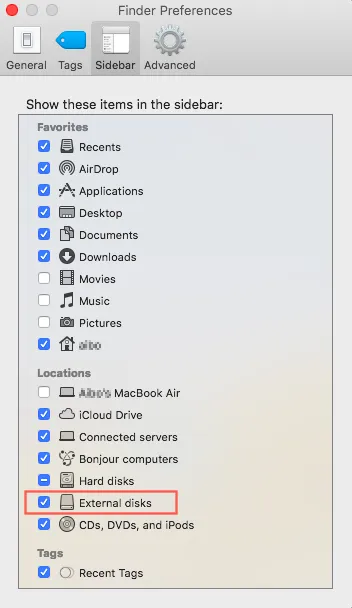
- Go to Finder > Preferences > Sidebar.
- Tick "External disks" in the Sidebar tab to show Seagate Backup Plus external hard drives in Finder.
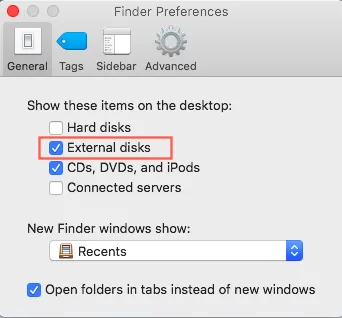
- Shift to the General tab.
- Check "External disks" under "Show these items on the desktop" and your connected Seagate Backup Plus drive will appear on the Mac desktop.
B. Seagate Backup Plus drive visible in Disk Utility but not mounted (Grayed out)
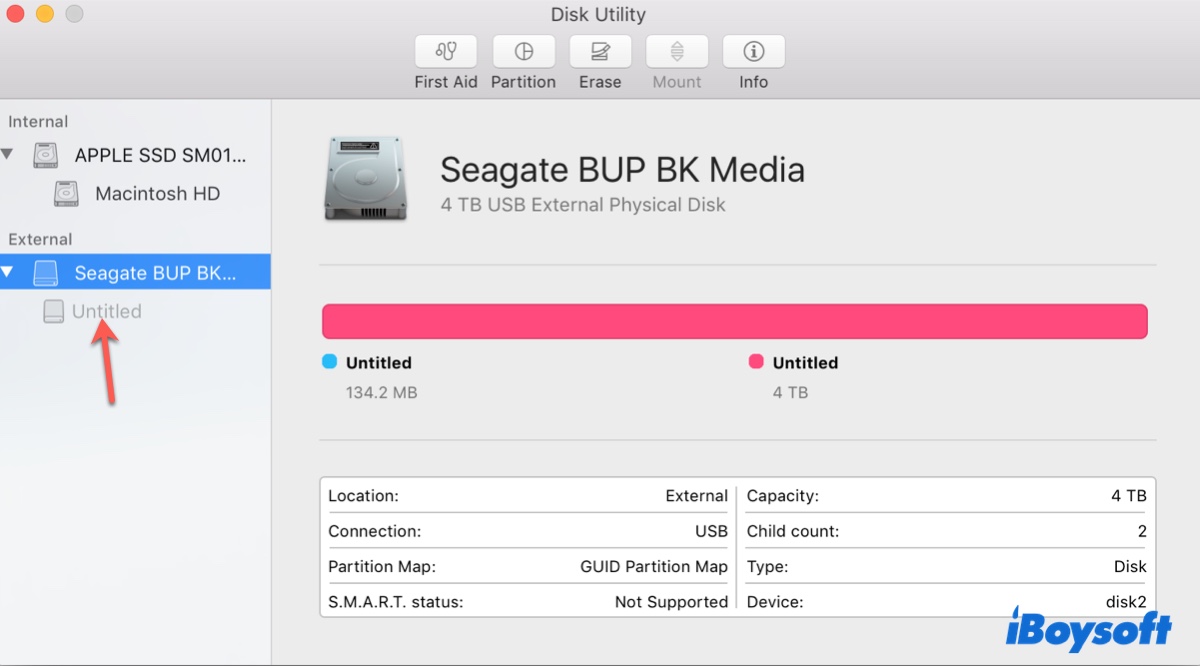
→ Can be mounted normally → no serious issue (macOS can see it, but can't access it)
→ Cannot be mounted / errors → likely file system corruption
C. Seagate Backup Plus drive not showing up in Disk Utility or Finder
→ Likely a hardware issue (cable, port, power, or the drive itself). Refer to: Seagate External Hard Drive Not Showing Up on Mac? Diagnose the Cause
If your case falls into B or C, follow the diagnostics below.
Safe Diagnostic Order (Do These in This Order)
The steps below are arranged in a safe diagnostic order. You can either follow them sequentially or jump directly to the solution that matches your case above.
Check the cable and power
When you find Seagate Backup not working on your Mac, it's natural to suspect that one of the hardware components is having an issue. Therefore, it's necessary to check whether the USB port, USB cable, your Mac, and the Seagate Backup drive itself are functioning well before proceeding to a solution. These basic checks should apply to the following issues:
- Seagate One Touch not showing up on Mac
- Seagate (Backup) BUP Ultra Touch not showing up
- Seagate Backup Plus Portable drive not showing up on Mac
- Seagate Backup Plus Slim not detected
- Seagate Backup Plus Ultra Touch not recognized
Check these if you notice Seagate Backup not showing up on Mac:
- Replug the Seagate Backup Plus drive and verify if the drive light is on. Desktop drives typically require a power adapter.
- Try a different USB port or USB cable to see whether the USB port or cable is bad.
- Connect the Seagate Backup Plus drive to another Mac or PC and see if it is compatible with it.
If, after trying these fixes, your external drive still won't appear in Disk Utility, it likely has physical damage or hardware problems. In this case, find professionals for help instead.
Mount the Seagate Backup Plus drive manually
Sometimes, the Seagate Backup Plus Portable drive may not mount automatically like it usually does. In this case, you can mount it manually in Disk Utility.
Steps to fix Seagate Backup Plus for Mac not showing up:
- Open Disk Utility.
- Right-click the Seagate hard drive from the left sidebar and then click the Mount button.
Warning: If you encounter I/O errors, unusual noises, or repeated mounting failures, do not continue trying fixes. These are strong signs of physical damage, and further attempts can reduce the chances of successful data recovery.
Repair Seagate Backup Plus drive via First Aid
If mounting fails, you can proceed to run First Aid to repair the drive. But only start it when you don't have critical data at risk, as repairs are not always safe. Note that First Aid may fix minor file system issues but can also fail if the damage is severe.
Here's how to check and verify the Seagate hard drive using First Aid:
- Open Disk Utility.
- Select the Seagate drive and click First Aid.
- Wait for the scan to complete.
If First Aid is successful, you can manually mount the drive again to access it.
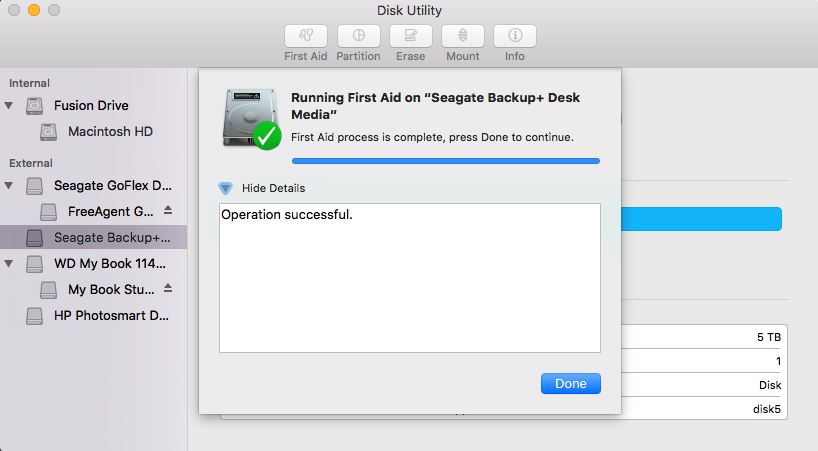
If First Aid is unable to repair the drive, it likely has severe file system corruption or an unsupported file system. Consider reformatting it to set up a new file system.
Note: Alternatively, you can download Seagate's software, like Seagate Dashboard, to diagnose, manage, and repair disk drive errors to fix Seagate Backup Plus not working on Mac.
If the Drive Is NTFS (Windows-Formatted)
If your external hard drive isn't specified as "for Mac," it's often formatted for Windows with NTFS. macOS can read NTFS drives by default, but it cannot write to them without third-party software. This limitation can sometimes make a drive appear unmounted or inaccessible, even though the hardware is fine.
Typically, two reasons can cause the issue:
- macOS sees the NTFS drive, but since it can't write to it, the system may not mount it automatically.
- The NTFS for Mac software on your Mac is no longer compatible with your system.
To handle the NTFS drive safely, you can switch to a compatible NTFS for Mac driver, such as iBoysoft NTFS for Mac, or reformat it with a Mac-compatible format.
If the Data Is Important
If the files on your Seagate drive matter, this is the point where your priority should shift—from fixing the drive to protecting your data. Avoid jumping straight into repairs or reformatting. Actions like repeated mounting attempts or running First Aid multiple times can sometimes make the situation worse, especially if the drive has underlying issues.
Be reminded that recovery success depends on the level of damage. Minor file system issues are often recoverable, but physically damaged drives are much more unpredictable. To improve the success rate, you should also save the recovered files to a different drive and avoid repeated scanning, as it can stress the drive and reduce the chances of successful recovery.
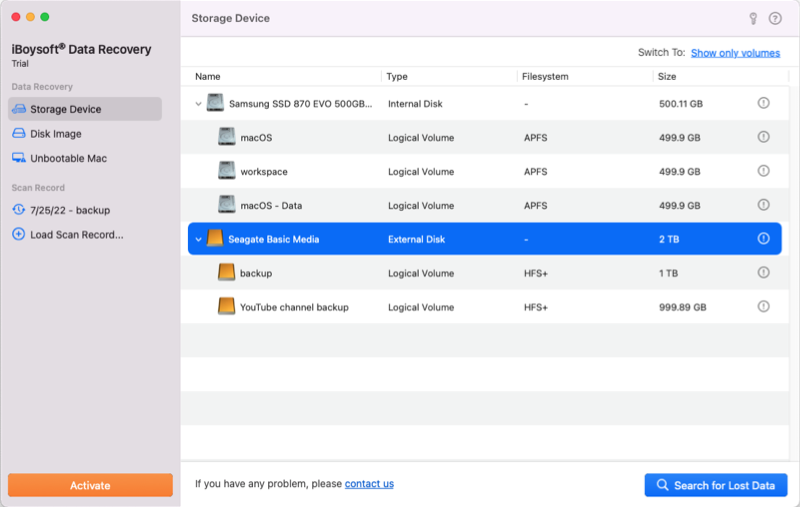
In the following paragraphs, we'll show you how to recover lost data from a Seagate Backup Plus drive with iBoysoft Data Recovery for Mac. It can retrieve data from a drive that's unrecognized, formatted, inaccessible, corrupted, unmountable, or unreadable. It also supports all macOS versions starting from OS X 10.7 Lion on both Intel and Apple Silicon Macs.
- Download, install, and launch iBoysoft Data Recovery for Mac.
- Select the Seagate Backup Plus drive you want to recover lost data from and click the Search for Lost Data button. (If your Seagate hard drive is showing up, it likely has hardware problems and needs technical help.)
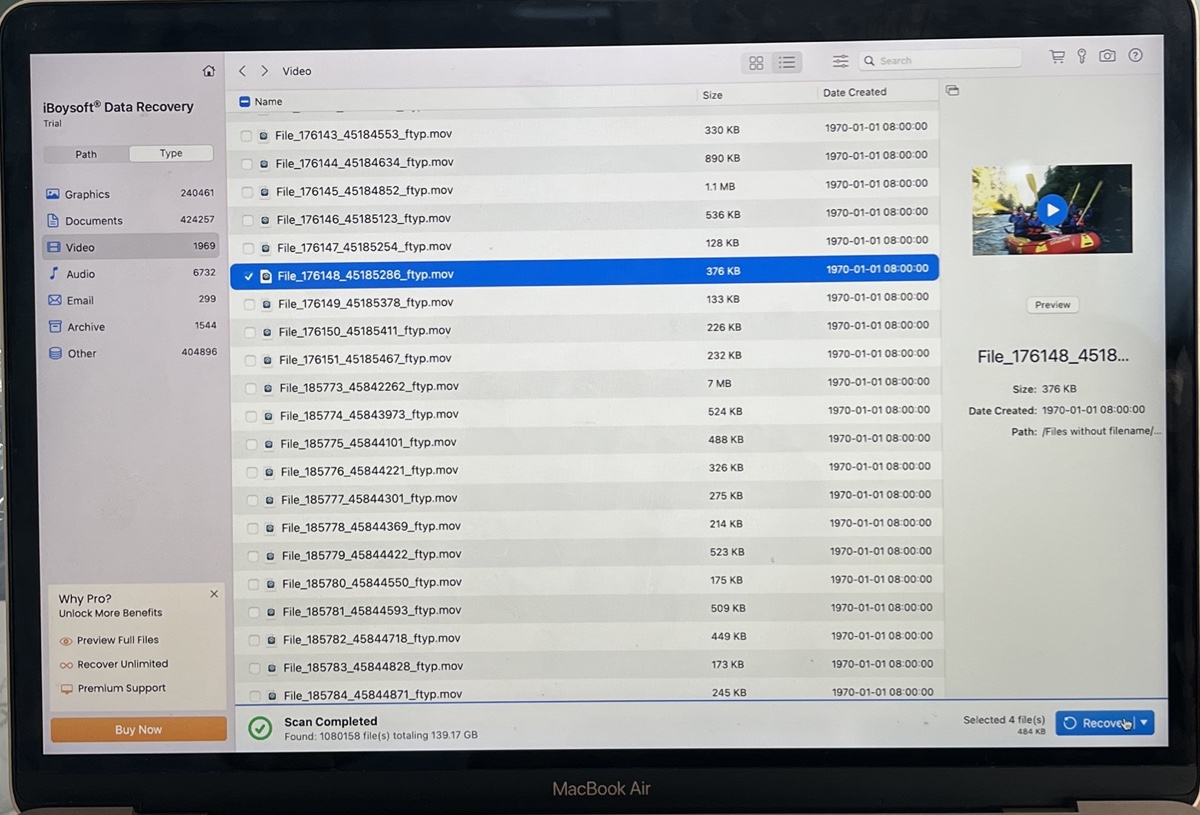
- Click Preview to preview the searching results, choose the files you need, and click Recover to get them back.
When Reformatting Is Actually Safe
You should only consider reformatting if all of the following are true:
- There is no important data on the drive
(or everything has already been backed up or recovered) - The drive appears physically healthy
No unusual noises such as clicking, buzzing, or repeated spinning attempts. - No clear signs of hardware failure
For example, frequent disconnections or persistent I/O errors.
If these conditions are met, reformatting can reset the file system and restore normal use. However, if there's any doubt about the drive's condition, it's better to avoid formatting and investigate further.
- Open Disk Utility.
- Click View > Show All Devices.
- Choose the physical disk of your Seagate Backup Plus drive or the grayed-out partition and click Erase.
- Name it.
- Choose a file system. (Used on Mac only: APFS is the best for SSDs; Used on macOS & Windows: exFAT is recommended.)
- Keep the scheme as GUID Partition Map.
- Click Erase.
For more details on choosing a proper format or other format options, visit: How to Reformat External Hard Drives on Mac?
Why is your Seagate external hard drive not showing up on Mac?
There are various reasons that may cause a Seagate Portable drive not to show up on a Mac, and here are the common ones.
Causes of the Seagate Backup not showing up on Mac:
- A recent macOS update or software update could cause many types of incompatibility.
- The external drive is encrypted or password-protected, especially for the Seagate Backup Plus Ultra Touch hard drive.
- Faulty connections, such as the wobbly USB port and broken USB cable.
- Power supply failure, especially when the MacBook is in low-power mode, and external hard drives require extra power resources.
- The external drive has an outdated driver, as you haven't updated your software and hardware for a long time.
- A virus infection that comes from recently downloaded files, applications, patches, etc.
- External drive hardware errors, like bad sectors.
- Other unknown reasons.
FAQs
- QDoes Seagate Backup Plus work with Mac?
-
A
Yes, Seagate Backup Plus drives work with Mac computers. In fact, as long as an external drive has a file system that's compatible with macOS, it works on a Mac.
If your Seagate drive is formatted with NTFS, it's read-only on Mac and needs an NTFS for Mac driver to be writable.
If your Seagate drive is formatted with APFS, Mac OS Extended, FAT32, or exFAT, it doesn't need any extra tools to work on a Mac.
- QHow to set up Seagate Backup Plus on Mac?
-
A
To set up a Seagate Backup Plus on Mac:
1. Connect it to your Mac.
2. Open Disk Utility.
3. Select the drive to check its file system.
4. Reformat it with a Mac-compatible format if not already.