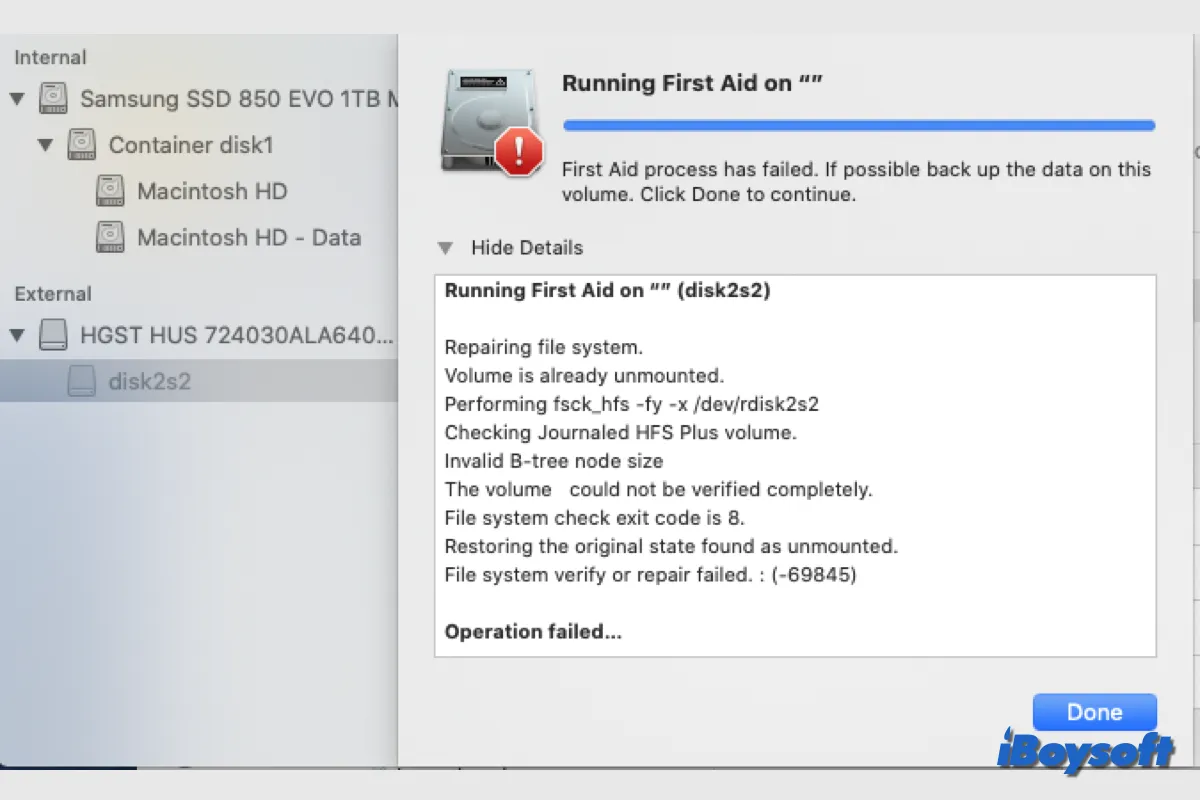
Some Mac users receive the error message "Invalid B-tree node size. This disk needs to be repaired" when running First Aid to check and repair the internal/external disk. This disk error usually manifests itself in the following phenomena:
- MacBook won't boot up
- Mac freezes
- The external hard drive is inaccessible
Solving the invalid B-tree node size error is necessary to use the internal/external hard drive normally and make the Mac function well. This post provides proven solutions for this disk error and tells how to recover data from your Mac if any files are lost. It applies to Intel and M-series Macs, HDDs, SSDs, and USB flash drives.
Understand the invalid B-tree node size error
A B-tree, a type of index table format, is used by Mac operating systems to generate a unique entry for each item you save. Upon attempting to access a file on the machine, the system searches through the B-tree for that file each time.
If it returns the "Invalid B-tree node size" error message after verifying the disk, it indicates that the system was unable to find (parse) the file you were trying to access in the B-tree. This consequently causes Mac corruption and data inaccessibility.
Reasons for the invalid B-tree node size error
The invalid B-tree node size error could occur in both Mac internal and external hard drives. You may want to know what causes the invalid B-tree node size error so that you can avoid the same mistake in the future. Here, we conclude some command reasons:
- Sudden shutdown
- macOS-related errors
- Corrupt file system
- Damage file catalog
Recover data from the drive with the invalid B-tree node size error
The invalid B-tree error on a Mac's internal or external hard drive could cause data loss. If you find that some items on your storage media are lost due to the invalid B-tree node size error, you could perform a data recovery before or after you reformat the drive.
iBoysoft Data Recovery for Mac, the professional data recovery software, is a good choice for you to recover data from internal and external hard drives on Mac. It delivers a high recovery rate, a risk-free environment, a Finder-like UI, etc. You can try it for free to scan and search for lost/deleted files from the drive with the invalid B-tree node size error.
Move to run iBoysoft Data Recovery for Mac in macOS Recovery Mode if your Mac is unbootable.
Steps to recover files from the drive with the invalid B-tree node size error:
- Download and install iBoysoft Data Recovery for Mac on your device.
- Open this data recovery software and select the target volume under Data Recovery > Storage Device.
- Click the Search for Lost Data at the bottom-right corner.
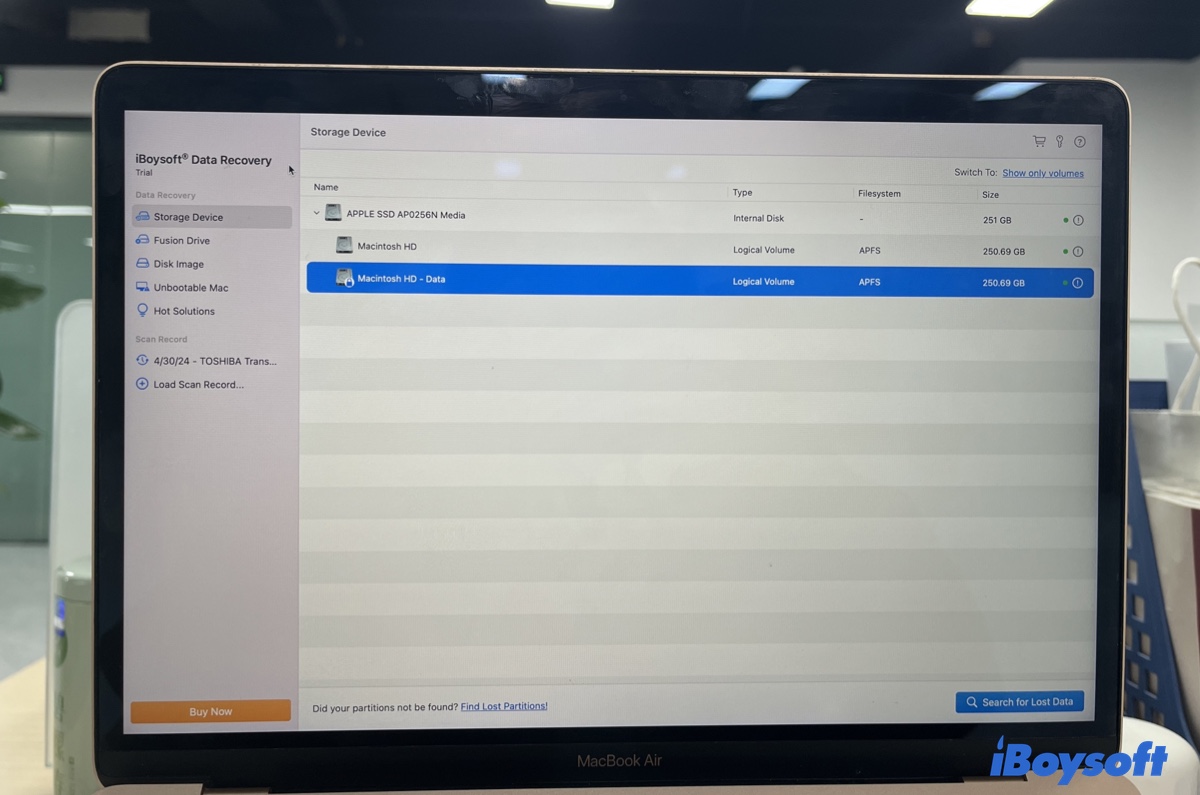
- Wait for the scanning to complete.
- Filter the found files and preview them.
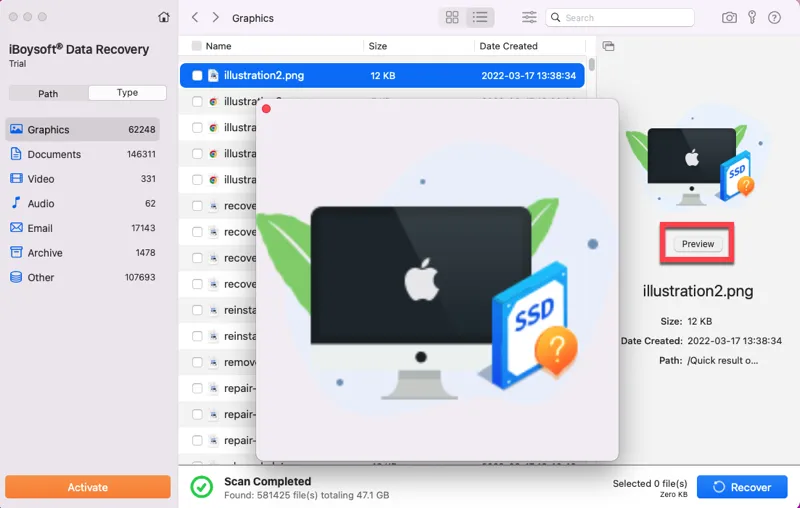
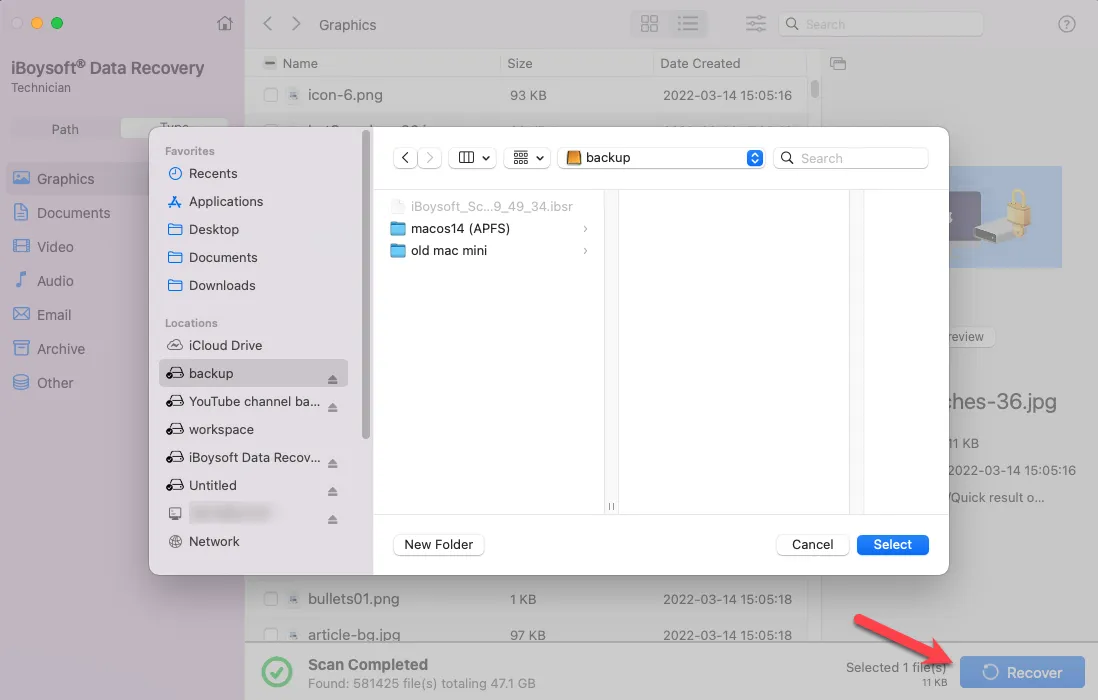
- Tick the wanted items and click Recover.
- Choose a different location to save the recovered files.
Fix the invalid B-tree node size error on Mac (Step-by-step)
An internal/external volume with the invalid B-tree node size error could prevent your MacBook from booting up, render the drive's data inaccessible, cause your Mac to freeze, etc. To fix this error, you can apply the methods below:
Run Disk Utility First Aid
While you may receive the invalid B-tree node size error because Disk Utility First Aid can't repair your Mac's internal drive or a connected external HDD, SSD, USB flash drive, etc., running it again sometimes fixes the problem.
- Enter macOS Recovery Mode if the Mac is unbootable or you want to repair a startup disk.
- Access the Disk Utility from the macOS Utilities screen in recovery mode, or open Disk Utility from Finder > Applications > Utilities after successfully booting up the Mac.
- Click View and choose Show All Devices.
- Select the volume with the invalid B-tree node size error and click First Aid.
- Click Run to begin checking the selected volume for errors.
If First Aid fails to repair the invalid B-tree node size error after several attempts, you can try other methods below.
Run the FSCK command
In addition to the Disk Utility First Aid, you can also run the FSCK (File System Consistency Check) command in the Single User Mode to fix internal and external disk errors, such as "Invalid B-tree" on Intel Mac. Here's how:
- Press and hold Command+S while rebooting your Mac to boot up into Single User Mode.
- In the terminal window, type the following command and press Return. /sbin/fsck -fy
- Once the command is done, type the command below and press Return. reboot
Reformat the drive
In case both the methods above don't fix the invalid B-tree node size error on Mac, you can try the last resort—reformatting the drive. This will erase all the drive content. You should first back up your drive with Time Machine or other tools. Then, follow the steps below to reformat the drive with the invalid B-tree node size error:
- Open Disk Utility from Launchpad or access Disk Utility in macOS Recovery Mode.
- Select the problematic disk/volume in the left list of Disk Utility.
- Click the Erase button on the top toolbar.
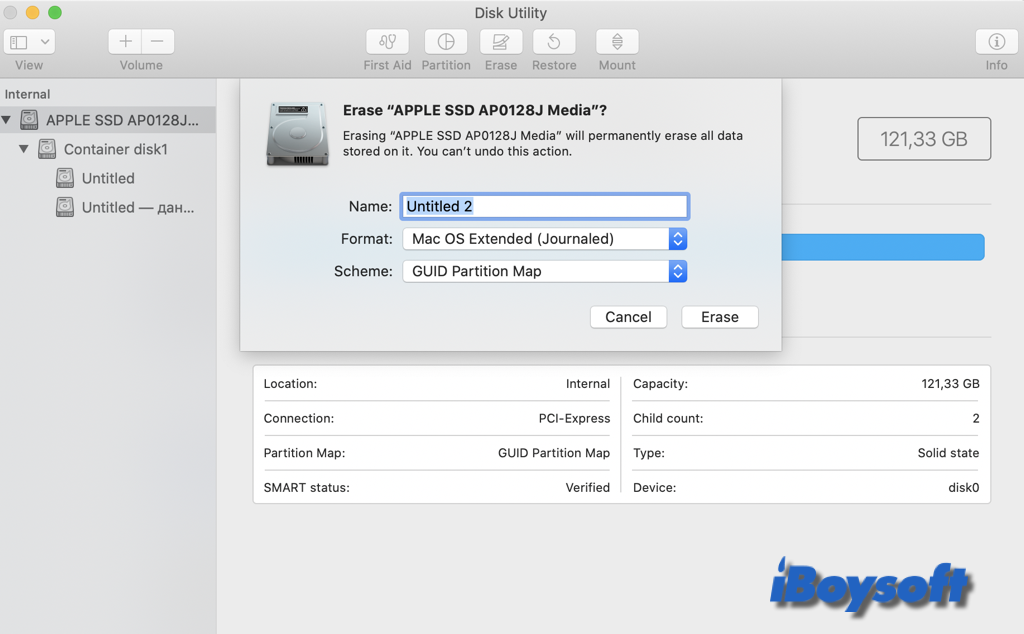
- Enter a name, choose a format, and select a scheme.
- Click Erase to begin the reformatting process.
If you have fixed the invalid B-tree node size error with the steps above, share it with others!
How to avoid the invalid B-tree node size error?
To prevent your hard drive from the invalid B-tree node size error and similar errors, which may cause your drive to be inaccessible, exercise your Mac with the following tips:
- Keep a regular backup of your drive.
- Ensure your hard drive is healthy before performing a macOS upgrade.
- Avoid accidental shutdown or power outlet.
- Turn off FileVault or decrypt your startup disk before repairing your disk.
Conclusion
When First Aid failed to repair your drive with the "invalid B-tree node size" error, you can recover data first if you've lost access to the drive, then run First Aid again to auto-repair the file system. If it doesn't work, run FSCK in Terminal to perform a deeper repair. The last resort is to reformat the drive after backing up its data.
FAQs
- QWhat actually is an Invalid B-tree Node Size error?
-
A
Think of your hard drive like a massive library. The B-tree is the card catalog that tells the computer exactly which shelf every file is on.
When you see the 'Invalid B-tree Node Size' error, it means the catalog has been physically or digitally scrambled. The computer knows the books are there, but it can no longer read the map to find them. On Apple Silicon Macs, this often happens if a drive is unplugged while it’s still writing 'catalog' data.
- QCan I fix a B-tree error without losing my data?
-
A
Yes, you can fix a B-tree error without losing your data with a data recovery tool, which can bypass the B-tree to find your files.